By Bri Brands
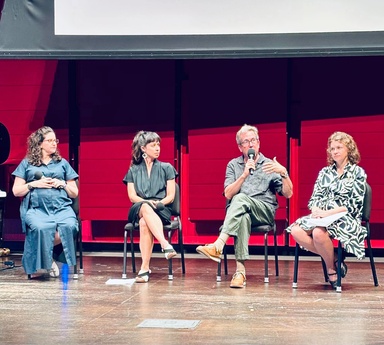
To Stephanie Miracle, dance doesn’t have to happen on a stage. It can unfold along a riverbank or take shape through an unexpected collaboration, creating opportunities to rethink how people experience movement.
That approach has earned Miracle, an assistant professor in the Department of Dance, the inaugural Obermann Interdisciplinary Achievement Award.
Presented by the Obermann Center for Advanced Studies, the award celebrates scholars whose interdisciplinary collaborations lead to discoveries that would not be possible within a single field. Miracle’s work exemplifies that mission, incorporating dance with other disciplines through collaborative performances and projects that explore movement beyond traditional settings.
"It is a huge honor, especially because I see so many people who are deserving of an award like this,” Miracle said. “I feel lucky to be in a place like the University of Iowa where there are a lot of interdisciplinary artists or researchers around."
Finding new possibilities beyond the stage
Playfulness is central to Miracle's approach to choreography. She is particularly interested in how dance interacts with different environments and what happens when artists work alongside people from other disciplines.
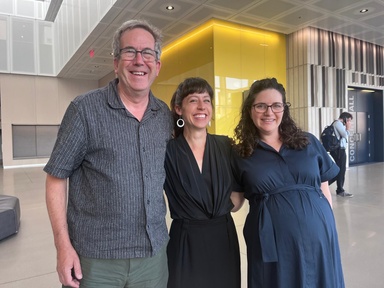
One example is Meandering River, a 2025 site-specific performance that brought together artists and researchers to explore the relationship between the Iowa River and the surrounding community, co-directed with Eric Gidal in the Department of English; Jenna Supp-Montgomerie in the Department of Communication Studies; and the School of Art, Art History, and Design's Heather Parrish and Elizabeth McTernan.
The experience challenged Miracle to expand her role beyond choreography, taking on responsibilities as an organizer and facilitator while considering how to produce work involving multiple disciplines.
Her collaboration with Deema Totah, an assistant professor in the College of Engineering, took a different approach. Together, they brought dancers and robots into conversation through movement in Since We Have Come This Far, How Do We Get Back?, a performance featuring robots interacting with dancers.
"I'm interested in working with other scholars and thinkers who are both experts in their field but also have a real curiosity and openness to explore areas they're less familiar with,” Miracle said. “There's something really exciting about moving into the unknown with someone and developing new methods alongside them."
Inspiring curiosity in the classroom
Miracle’s interdisciplinary approach extends beyond her performances, shaping how she teaches and encourages students to explore new possibilities through dance: "I encourage my students to follow what they’re interested in, resist conventional borders, go down new trails, see what happens in conversation with other people, and invent new forms through this."
Looking ahead, Miracle is collaborating with Dean Bakopoulos, chair of the Department of Cinematic Arts, on a traveling live-cinema dance experience set to take place in Germany in 2027, supported by the Arts and Humanities Initiative Major Project Grant. Drawing on Bakopoulos’ screenwriting expertise, the project will explore how choreography can unfold across urban spaces.
Although the Obermann Interdisciplinary Achievement Award recognizes Miracle individually, she sees it as a reflection of the many people who have contributed to her work. She hopes to deepen those relationships through longer-term collaborations and new opportunities to work across departments.
"I want my students to work diligently within the discipline of dance, and to push themselves beyond that categorical edge—to also know that their work is valuable beyond just dance arenas," Miracle said.