By Jessica Lien
Richard Brent Turner's scholarship explores the relationship between religion and music, particularly within African American history and culture. His path toward that work began with an early interest in language and religion and was shaped by his experiences growing up in Boston during the Civil Rights Movement.
Turner is a professor of African American religious history in the Department of Classics and Religious Studies in the College of Liberal Arts and Sciences (CLAS). He earned a PhD in religion from Princeton University in 1986.
His first major book project grew from what he saw as a gap in scholarship about Islam in the United States, particularly African American Islam. A new introduction to the book's second edition assesses the impact of 9/11 on African American Muslims, the growth of a mainstream Islamic community among Black Americans, and the contemporary interactions between Islam and hip hop culture.
After moving to New Orleans and experiencing the city's musical and religious traditions firsthand, his research changed direction.
Jazz funerals, the second line, and evolving scholarship
"Getting out of the classroom at Xavier University of Louisiana, going into the streets and churches, and connecting with artists—jazz musicians, poets, people writing books on New Orleans—I saw how all these things were linked together," Turner said.
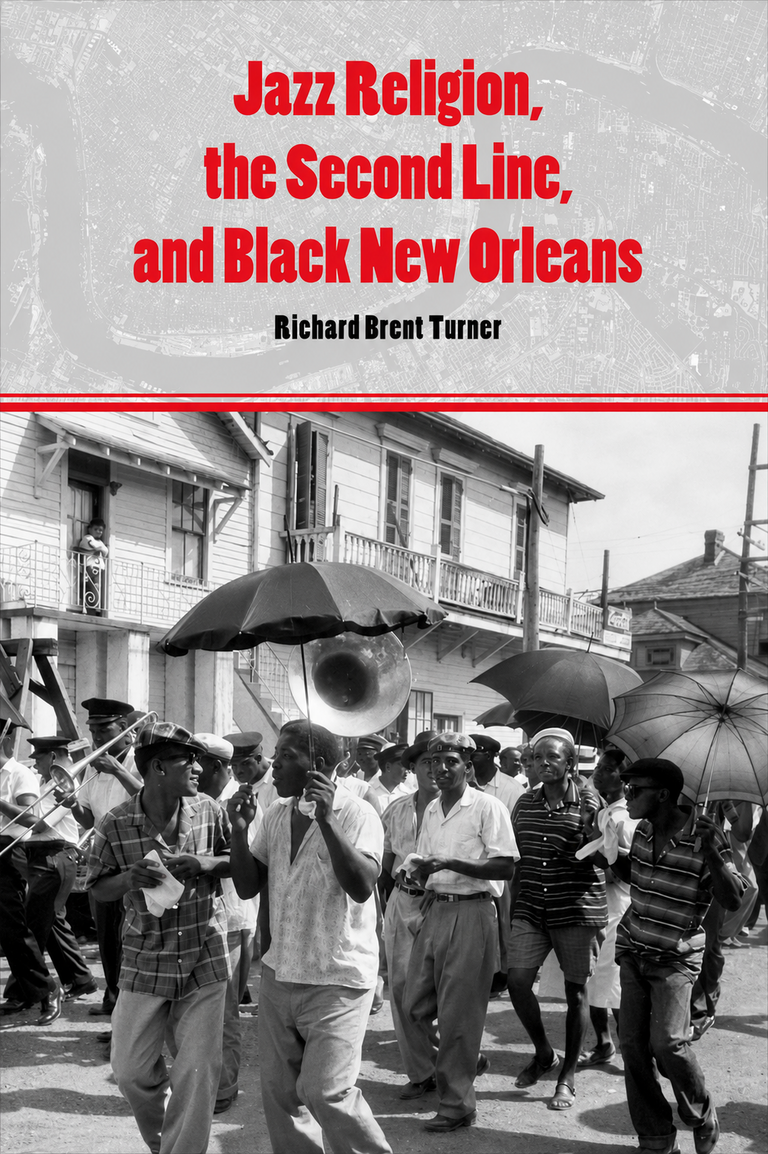
Turner studied the intersections of Black Protestantism, Black Catholicism, West African religions, and African diaspora traditions, and attended and documented jazz funerals.
Those experiences brought his training in history, religion, and anthropology together with his lifelong interest in music, allowing him to see how religious traditions, cultural expression, and community life intersected outside traditional academic boundaries.
The work also became deeply personal in 1997. Turner's mother died unexpectedly during his first summer in New Orleans. Participating in jazz funerals helped him understand not only their historical and religious significance, but also how communal traditions surrounding music, movement, and ancestors can help people experience and express grief.
"At the end of a jazz funeral, after I wrote my fieldwork notes, I felt like grief had been lifted out of my body," Turner said. "It has a way of uplifting you, of shifting your perspective about yourself and the universe at that particular moment. My personal involvement and experiences in religious rituals and friendships with community leaders and families in New Orleans brought a depth of understanding to my scholarship that was just as important as fieldwork and historical research." Those experiences informed another book: Jazz Religion, the Second Line, and Black New Orleans.
Turner’s later scholarship continued to bring together music, religion, and history.
His 2021 book, Soundtrack to a Movement: African American Islam, Jazz, and Black Internationalism, examines jazz musicians and their connections to civil rights and human rights. It was a finalist for the 2022 PROSE Award in Music and the Performing Arts and received a Certificate of Merit for Best Historical Research on Recorded Jazz from the Association for Recorded Sound Collections.
Evolving scholarship in CLAS
Turner’s courses connect religion, music, civil rights, and human rights, giving students opportunities to examine cultural traditions through multiple perspectives.
He came to Iowa in part because of the opportunities it offered to continue working across disciplines while pursuing his scholarly and creative interests.
"I wanted to be at a nationally known research university with a reasonable teaching load and support for research and writing books," Turner said.
Mentoring students and sharing what he has learned from his time in New Orleans have become important parts of that work.
After Hurricane Katrina in 2005, which flooded 80% of the city and displaced thousands of Black New Orleanians, Turner returned to New Orleans to help with the recovery efforts of his friends.
"I offered a course on religion, music, and culture in Black New Orleans that helped a lot of the students get an orientation to the city and the culture of New Orleans before they were going down there to help rebuild the city after Hurricane Katrina," said Turner.
The course brought the same approach that had shaped Turner's own scholarship back into the classroom: understanding religion, music, history, and lived experience as connected rather than separate subjects.
"Here at the University of Iowa, I really have found a great audience of students for the courses in which I make these links between religion and music, and religion and civil rights and human rights that I love to teach,” Turner said.