By Jessica Lien

About a decade ago, Dan Junis signed up for an improv class at Riverside Theatre in Iowa City. He was afraid of public speaking, and improv presented a particular challenge: there were no notes and no script to fall back on. Instead, he had to rely on fellow performers to create the scene and story on the spot and develop the action together as it unfolded.
Attending the class began as a personal challenge but became a passion. Junis now performs with local improv groups and teaches the same class.
“Yes, and—” is a central tenet: accept what someone offers and build on it, rather than stating the reasons it doesn’t work or changing the subject.
A scene partner announces the two of them are stuck in an elevator. Responding with “Yes, and the music keeps getting louder,” keeps the scene alive, whereas “What elevator? We’re at the beach,” kills it.
“In improv, acceptance and listening are the most important things,” Junis said. “If you truly listen, then the rest just comes very naturally.”
Improv at work
As an academic program associate in the College of Liberal Arts and Sciences’ Department of Psychological and Brain Sciences, Junis serves as the department’s graduate coordinator. He manages teaching assistant assignments for more than 60 graduate students, navigates funding arrangements, hires additional teaching assistants, and coordinates schedules across undergraduate psychology courses.
It’s a role with plenty of moving parts, and Junis values the room his department gives him to manage them.
“What I like a lot about my job is the autonomy that it affords me,” he said. His supervisor, Ruthina Malone, and his colleagues trust him to decide how best to get the work done.
And he gets it done by applying concepts from improv almost daily.
For example, in a meeting to pitch ideas to reach a bigger audience, someone may suggest hosting more events. A colleague may build on the idea: What if the events happened every week, in a different spot on campus?
Another colleague could spot an error in the pitch: “You meant October 12, not 14, right?”
It would be a fair catch, and Junis said it’s worth considering in some contexts. But when a room is generating ideas, stopping to fix the date stalls the momentum and shakes the confidence of the person who pitched it. An incorrect date probably won’t derail the goal in that context, he said.
“That’s a super hard instinct to kind of train yourself out of,” he said. “The best way to be collaborative is to find the strengths in what the people around you are contributing.”
Embracing uncertainty
A recommendation from a support group participant familiar with Junis’ work led to a collaboration with Kristin Bowers, a licensed mental health counselor in the Carver College of Medicine’s Department of Psychiatry.
Junis led six improv sessions for patients with obsessive-compulsive disorder (OCD), giving participants a supportive place to practice navigating uncertainty. His unit later recognized him at a department-wide meeting for his contribution to the OCD improv pilot program.
In a game called “New Choice,” Junis calls out from the sidelines, and players must replace the last thing they said with something new. On the spot. Sometimes five times in a row.
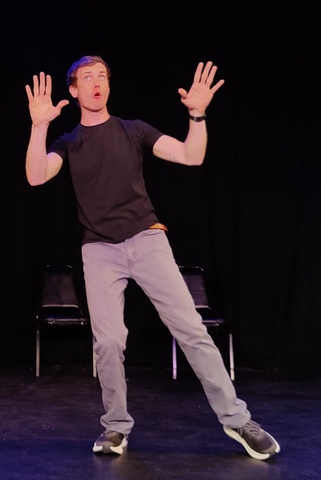
“As you can imagine, that causes stress,” he said.
But that’s part of the exercise. Participants practice managing their reactions, adapting to unexpected demands, and continuing even when they aren’t sure what to say next.
What happens if you freeze? During one exercise, a participant did just that.
Junis didn’t supply an answer. Instead, he turned the participant’s attention away from their own thoughts and toward their scene partner.
“Just focus on your scene partner. What are they doing? Get inspired by what they’re doing,” Junis told the participant.
The participant found something to respond to, and the scene continued. In later exercises, Junis said, they began responding more quickly by shifting the focus from internal noise to external focus.
Junis watched participants become more willing to take risks, even when the exercises made them uncomfortable. They practiced how to take action despite anxiety or uncertainty while finding encouragement through the shared experience of creating something together.
At the end of the final session, Junis invited participants to share something they were grateful for, a tradition he calls the “campfire of gratitude.”
One participant hated every minute of the exercises. Still, he was grateful for the experience and the chance to recognize his own progress in a place where he felt safe being vulnerable.
“I think the great thing about improv is that it conditions you to embrace uncertainty, and more importantly, trust yourself,” he said. “Because ultimately, it teaches you to trust that you will know what to do when you need to do it.”