By Jessica Lien
When NASA's Artemis II mission launched, Amanda Acevedo (BA ’96) watched from a conference room
near Johnson Space Center in Houston, surrounded by colleagues who had spent years helping prepare the spacecraft for flight.
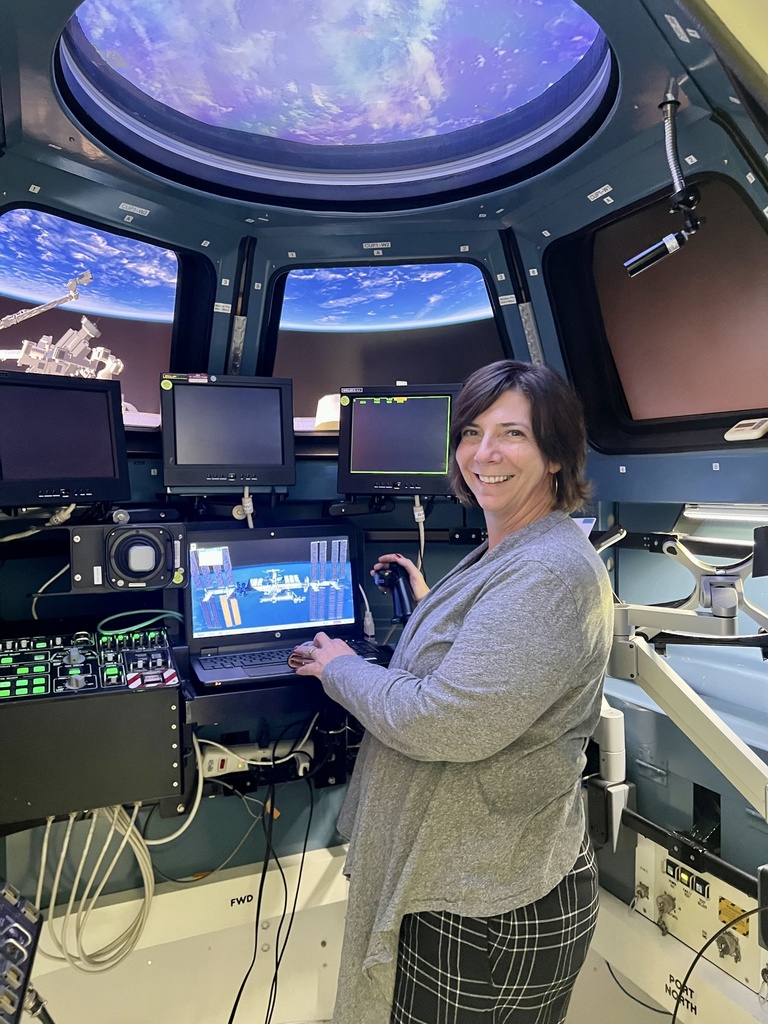
Among the images on the screen were displays the astronauts used inside the Orion capsule; displays her team at Vedo Systems had helped develop and test.
"There's nothing like it," Acevedo said. "The joy of watching your team's hard work literally take off is incredible."
For Acevedo, who earned her bachelor's degree in physics from the University of Iowa in 1996, the launch marked another milestone in a career spanning work with national laboratories, NASA, and entrepreneurship.
Today, she is the founder and president of Vedo Systems, a Houston-based software engineering company that supports NASA's human spaceflight programs. Although her work has taken her into some of the most technically demanding environments in aerospace, she traces much of her career to opportunities she received as an undergraduate in the College of Liberal Arts and Sciences’ Department of Physics and Astronomy.
Finding her direction at Iowa
Growing up near Chicago, Acevedo knew she enjoyed physics and journalism, but wasn't certain which field she wanted to pursue. Iowa appealed to her because she could explore both interests while receiving a broad liberal arts and sciences education.
She ultimately majored in physics and minored in computer science, a combination that would prove especially valuable in her career.
Acevedo remembers the accessibility of CLAS's physics faculty and their willingness to give students opportunities to learn through experience.
"I'm not sure I would have stuck with physics without the faculty at the University of Iowa in the physics department," she said.
That support led to undergraduate employment in the department and summer internships at Fermilab, a national particle physics laboratory near Chicago.
Working on an accelerator experiment helped Acevedo discover that she enjoyed developing the equipment and software that made scientific research possible.
Those experiences also helped her land her first job after graduation: developing control system software for the ATLAS accelerator at Argonne National Laboratory.
There, she gained experience with user interfaces, applications, and the integration of hardware and software. When an opportunity arose to develop software supporting NASA's human spaceflight programs, she readily accepted and moved to Houston.
Building a career in spaceflight
Acevedo spent years supporting NASA through private contractors before becoming a NASA civil servant. She later joined a Houston aerospace startup, where she gained experience building teams, working with customers, and growing a business.
Eventually, she decided to establish her own software engineering company.
Founded in 2016, Vedo Systems began supporting Lockheed Martin's work on NASA's Orion spacecraft. As the company grew, it expanded its involvement in other spaceflight programs, including Gateway, Space Reactor 1, Moon Base, and projects with Axiom Space.
Much of Acevedo's work now involves collaborating with engineers and customers to determine what software spacecraft need, how those systems should function, and how to test them before flight.
Her team develops software for spacecraft systems ranging from onboard displays and controls to guidance, navigation, and control. They also develop simulations that allow engineers to evaluate software and spacecraft systems before they are used in space.
"An undergraduate degree in physics really gives you the language to speak to a lot of different people," she said.
Understanding the scientific principles behind spacecraft systems allows her to communicate with specialists in areas including power, communications, and controls. And it helped her better understand what they need from her company's software.
For Acevedo, the combination of physics, computing, and a liberal arts and sciences education has been particularly useful in a career in which understanding different systems—and the people responsible for them—is essential.
Continuing to collaborate with CLAS
Although Acevedo has built her career in Houston, she has maintained close relationships with Iowa faculty and students.
Those connections recently supported a new research and development project at Vedo Systems: Whetstone, a machine-learning-informed tool designed to detect unusual patterns in data and provide early indication of system degradation in complex systems before failures occur.
As her team developed an early prototype, Acevedo knew they needed real-world data to determine whether the software performed as intended. She reached out to former Iowa faculty contacts and was connected with David Miles, associate professor and deputy director of research operations in the Department of Physics and Astronomy.
Miles and a collaborator at the University of Calgary, Andrew Howarth, helped Acevedo's team access and interpret data collected by the CASSIOPE satellite as part of their Enhanced Polar Outflow Probe (e-POP) project. The data provided an important test for Whetstone, helping the team evaluate its performance outside a simulated environment.
Initial results were promising, and Acevedo later returned to Iowa with three colleagues to share what they had learned and receive additional feedback from Miles and his colleagues.
She hopes the technology will eventually be useful to Iowa researchers, potentially helping them monitor satellite systems on the ground or during spaceflight.
The collaboration is one example of how the relationships Acevedo developed during her undergraduate years continue to shape her professional work.
"Being able to discuss ideas with faculty at Iowa is immeasurably valuable," she said.
Acevedo also gives back through CLAS's Dean's Advisory Council and supports student research through the annual Acevedo Poster Contest in the Department of Physics and Astronomy. She particularly enjoys helping students prepare résumés, practice interviews, and explore professional opportunities.
Creating opportunities for others
Of all her career accomplishments, Acevedo said she is most proud of the team she has built at Vedo Systems.
She values creating an environment in which colleagues respect one another, offer support, and celebrate their shared accomplishments.
"Building the Vedo Systems team has been the best part of my career for sure," she said. "It's an approach that reflects the encouragement she received at Iowa, where her teachers gave her opportunities to try unfamiliar work, ask questions, and develop confidence.
For students considering physics, she encourages pairing their interests with practical experiences and complementary skills that can help employers recognize their potential. Her advice for current students is to build relationships with faculty, pursue hands-on experience, and embrace that learning difficult material takes time.
"It is hard. It's supposed to be,” she said. “You have support, and it's worth it."