By Claire McGranahan
When a University of Iowa graduate student studying photography visited Johnny Brian's personal darkroom, she was enamored by the space. Later, at a university event the Pasierbs hosted, she shared this with his wife, Caroline.
"She said, 'I dream about his darkroom,'" Caroline recalled.
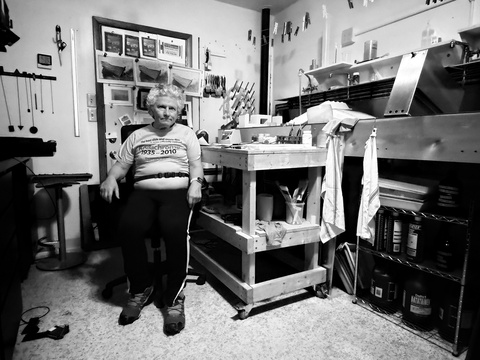
It's easy to understand why. Johnny Brian's darkroom is in a house converted into working space devoted to the art of making photographs, with separate areas for reviewing, preparing, developing, and matting and framing prints.
In the house, series of photographs—farm life in black and white; astrophotography of the Milky Way, comets, and the Northern Lights in Iowa; a striking sequence of self-portraits as Johnny Brian grew his hair out during the pandemic—fill the walls alongside placards, creating galleries worthy of the museums his pieces hang in. These rooms also hold decades of negatives, prints, and equipment.
For Johnny Brian, this studio has long been a place to experiment, refine his techniques, and turn the moments he captured into tangible, timeless art. Now, he and Caroline are helping create that kind of opportunity for students in CLAS's School of Art, Art History, and Design: the couple is funding a new darkroom, planned for 2028, that will expand opportunities for students to explore photography through hands-on, analog development processes.
Life at the intersection of art and science
Johnny Brian's interest in photography began when his parents gave him an Instamatic 100 camera at age six. He still owns the camera, which continues to work.
"My interest in photography has not faded since that day," he said.
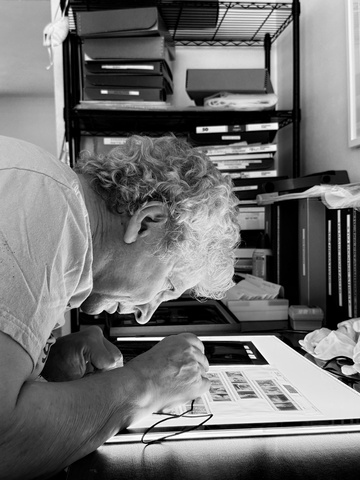
Photography remained a constant interest throughout his career in chemical and biological research laboratories, where he spent decades working as a researcher and laboratory director. His professional career also brought him to the University of Iowa, where he completed a post-doctoral fellowship in cardiovascular research in 1995.
His scientific background helped shape his approach to making photographs. Working primarily with medium- and large-format black-and-white film, Johnny Brian applies his knowledge of laboratory process control to photography, conducting formal tests of film and developers to achieve precise results in the darkroom.
His preferred technique is silver gelatin printing, a traditional method of producing black-and-white photographs. He also works with gum bichromate printing, an alternative process that uses light-sensitive materials and pigments to create images on paper.
Despite decades of experience and an evolving body of work, what Johnny Brian enjoys most about photography has remained unchanged.
“Creating an image, making something from nothing; this is what has kept my interest in photography over the years,” Johnny Brian said.
Recognizing potential in Iowa's photography students
When the Pasierbs first toured the university's photography facilities, they were impressed by what students were accomplishing, yet surprised by the supplies available to them.
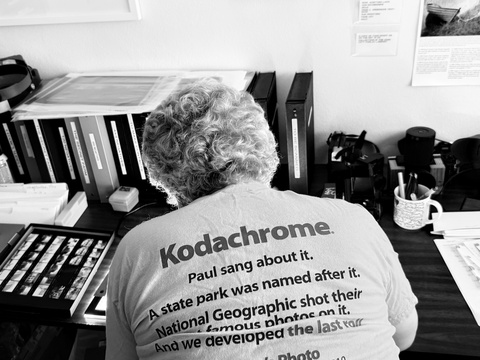
"I thought the Section on Photography was doing some innovative work on very limited resources," Johnny Brian said. Having worked in darkrooms for much of his life, Johnny Brian understood how access to a well-equipped space could shape an artist's creative possibilities.
Through the Brian Pasierb Family Foundation, the couple began supporting Iowa's photography program with equipment and student travel opportunities. Their foundation also sponsored a visit by photographer Alan Ross, a former assistant to Ansel Adams, to share his experience with students through classroom and darkroom instruction.
The Pasierbs’ relationship with the program has since grown into a larger investment: the new darkroom that will give future generations of Iowa students more opportunities to develop their photographic practice.
“We are eager to showcase this new space with more visiting artist workshops in the future,” said Thalassa Raasch, area head of photography and director of undergraduate studies in the School of Art, Art History, and Design’s studio division.
Creating new possibilities for the next generation
The renovated darkroom will allow Iowa to teach more photography students at once while providing space for larger prints, easier transitions between film formats, and more efficient instruction. Rather than moving between classrooms on different floors, students will be able to complete their darkroom instruction in one space.
The expanded facility will also create opportunities for new artistic exploration, including mural darkroom printing, a collaborative analog process that produces photographs measuring 30 by 40 inches or larger. And, it will incorporate examples of Johnny Brian's work, with photographs displayed publicly and additional prints available as teaching resources.
“In his archived work, our students will see complex processes like gum bichromate printing visualized, and see examples of finished professional prints, elevating both their learning experience and their ambition,” Raasch said. She expects the new facility to strengthen Iowa's national reputation in photography and attract students seeking opportunities to study analog and alternative photographic processes.
For Johnny Brian, the value of traditional photography goes beyond preserving a traditional art form.
"Analog photography is the future of photography, in my opinion, due to the rise of AI and its impact on standard digital photography,” he said.
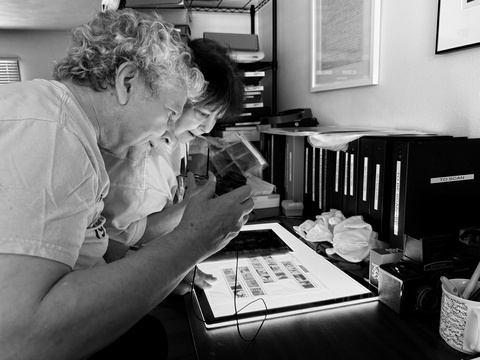
As photography continues to evolve alongside new technologies, understanding the medium's history remains essential to a well-rounded artistic education, said Rachel Cox, associate professor and former area head of photography in the School of Art, Art History, and Design.
“Analog and alternative photographic processes possess a handmade quality that is relative to the individual creating the piece,” Cox said. “This is something unique and tactile, where errors and faults within the processes become hallmarks of a real human being at the center of its creation.”
For Caroline, the darkroom project is especially meaningful because it reflects something Johnny Brian has cared about for nearly his entire life. She describes the new facility as his vision, and one that she, as his partner in life and in the darkroom in recent years, is happy to support.
The Pasierbs share a particular hope for those students, including the ones who will arrive at Iowa long after the new darkroom opens.
"I would hope that some students would be inspired to become the next Ansel Adams or Wynn Bullock," Johnny Brian said. "Then, my work will be finished."