By Fatima Salinas
For Matthew Brown, studying literature means looking beyond the words on a page. His work explores the history of reading and the ways readers, physical books, and the world around them shape how people understand a text.
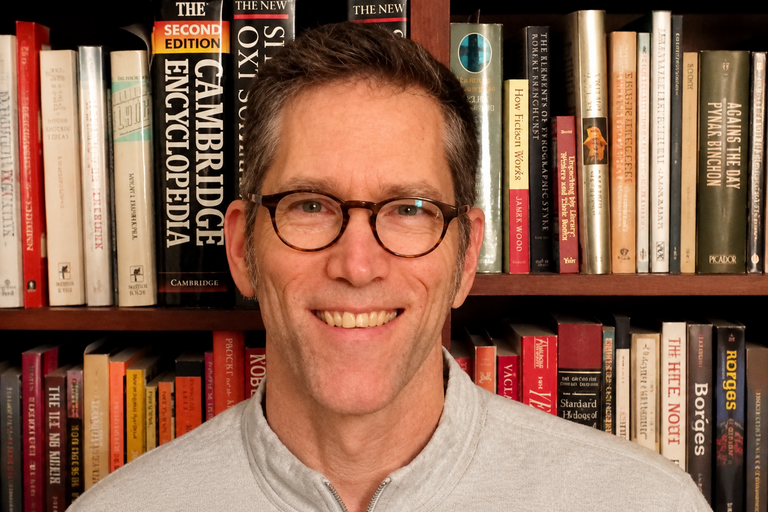
As a professor in the College of Liberal Arts and Sciences’ Department of English, Brown brings that same curiosity into his teaching. He encourages students to approach literature from different perspectives, look closely at books themselves, and remain open to what they discover.
That approach has roots in Brown’s own education. He attended an elementary school shaped by John Dewey’s progressive education model, where learning extended beyond the classroom through hands-on experiences, play, mistakes, and the freedom to follow one’s curiosity.
“My life as an educator has been strongly influenced by my K-6 schooling,” Brown said. “Learning by doing; playing and failing; stoking curiosity—these tenets run against a lot of the ways early education can be managed. The principles respect students as learners.”
Brown’s interest in literature grew during his undergraduate liberal arts education. Although he had enjoyed reading in high school, he said college changed the way he understood literature. Classroom discussions went deeper, and he began to see language as something to question and explore rather than simply read.
His research now asks similar questions about the people behind those reading experiences. Rather than focusing only on an author’s life, intentions, or genre, Brown looks at the evidence readers leave behind: personal writings, public reviews, notes in the margins, and the physical books themselves.
“The challenge is recovering what seems so intangible: the mental world of reading,” Brown said. “But readers create meaning too.”
Looking at the book itself

Brown’s interest in how readers create meaning also extends to the physical form of a book. Through his connection with the University of Iowa Center for the Book, he gives students opportunities to work with papermaking, lettering, hand-set printing, and binding.
These experiences allow students to consider how the way a book is made can influence the way it is read.
Brown brings that perspective into his courses. When teaching Moby-Dick, for example, he takes students to Special Collections in the UI Main Library to examine illustrated editions of the novel. Students consider how artists have portrayed the characters and the whale, treating those choices as interpretations of the story rather than simply images accompanying the text.
Hands-on projects give students opportunities to explore how books and other texts are made. In HIST:2190 The Book in Global History, which he co-taught with associate professor Elizabeth Yale, students recreated maps from pre-Columbian Mesoamerica, set type for a 19th-century abolitionist newspaper, and practiced calligraphy, papermaking, and East Asian woodblock printing traditions.
For Brown, these projects are not simply exercises in making. They give students room to follow their own interests and see where their questions lead. One student became interested in how East Asian woodblock printing could be moved from place to place and turned that question into a final project involving wood engraving and printing at locations across campus.
Another student became interested in the Renaissance tradition of the “wayzgoose,” an annual celebration held by a master printer for their crew, and developed the subject into a fictional piece.
The value of slowing down
For Brown, these experiences reflect a larger goal that connects his research and teaching: learning how to pay attention. His current work on Herman Melville and Iris Murdoch has further shaped how he thinks about that idea in the classroom.
“Much of the close study, historical research, and in-class activity I have been describing boils down to this: paying attention,” Brown said. “They have taught me that, in a world of ‘more, faster, better,’ it is both rewarding and fun to slow down with students and really attend: to words on the page, to a striking visual image, to each other.”
For Brown, slowing down creates space for students to engage with literature more fully. It allows them to question what they encounter, follow their curiosity, and develop interpretations of their own.