By Samantha Miller
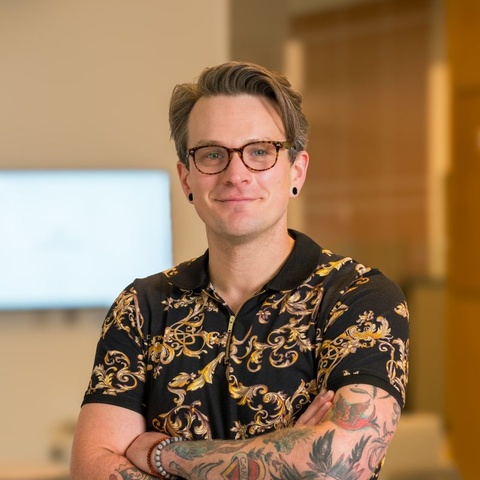
After completing a Master of Arts in Strategic Communication (MASC) at the University of Iowa while working full time, Del Belcher (MA ’23) is back in the virtual classroom, but this time as an instructor.
Belcher returned to the MASC program as an adjunct instructor to teach Inclusive Design for Strategic Communication, a course rooted in questions he began exploring as an Iowa graduate student.
Working backward
Belcher did not originally plan on a career in strategic communication. After earning his undergraduate degree from Spring Arbor University in 2007, he began taking on freelance digital communication and marketing work. What started as side work eventually became a career.
That idea of “working backwards” brought him to Iowa’s MASC program. Already established in the area of marketing and communications, Belcher wanted an academic foundation to complement what he had learned on the job.
“After more than 10 years in the industry, I had all the experience,” Belcher said. “I wanted to get some of the official education to back it up.”
Today, he manages marketing and communications for Commonwealth Associates, supervises a marketing team and teaches in the College of Liberal Arts and Sciences. While earning his MASC, he found opportunities to connect what he was learning in the classroom directly to his professional work.
One course in particular, Julie Kraft’s communication management course, helped Belcher strengthen the leadership skills he now uses as a supervisor. But it was a crisis communication course that led him to a question that would eventually shape his return to the program: How can communicators make sure the information they create is accessible to everyone?
Designing communication people can use
He began thinking about what happens when emergency information depends on someone being able to hear a warning alarm, understand a particular language, or use a certain technology. If the way information is communicated creates a barrier for the audience, simply getting the information out isn't enough.
“You can’t just strategically communicate with different audiences, but you have to meet them where they are,” Belcher said.
That interest led to an independent study and capstone project with the MASC program leader Joanna Krajewski. Over a year, Belcher studied how other graduate programs incorporate accessibility into their curricula and explored how those principles could be applied to strategic communication education at Iowa.
That work eventually became Inclusive Design for Strategic Communication, a course that draws on Belcher's own experience as a MASC student.
In the course, students examine accessibility across the materials they may encounter in their professional work, including podcast transcripts, video captions, alt text, accessible website and document headers, graphics and press releases. They also explore artificial intelligence in communication and how AI-generated materials can be evaluated through the same accessibility principles.
Belcher also draws on his experience as a student to shape how he teaches. He remembers the synchronous discussions in Julie Kraft's courses as an important part of his own education, particularly the opportunity to connect academic concepts with real-world professional experiences.
“You’ve got the theory, you’ve got what you do day to day, and then these class discussions really put it all together,” he said.
He has carried that approach into his own course, using synchronous class time for interaction, questions and discussion rather than primarily for lectures.
The goal isn't for every strategic communicator to become an expert designer. Belcher wants students to know enough to ask better questions about what they create and recognize when communication may not work for its intended audience.
“Inclusive design shouldn’t be an add-on,” Belcher said. “But instead, how do we make accessibility the root of everything we do?”
Bringing the student experience back
That connection between professional experience and graduate education was also important to Belcher as a student. He worked full time and became a parent while completing the MASC program, taking one course per semester and finishing the degree over roughly four years.
“The greatest part about the MASC program is that it truly did fit my lifestyle,” Belcher said.
For Belcher, that flexibility meant his professional experience could become part of his education. Problems from work could become material for class, while conversations with instructors and classmates offered new ways to think through those problems.
Now, he is bringing that same perspective back to the program, helping other working professionals connect what they learn in the classroom to the communication challenges they face every day.
“I came into the program with experience, but I left with a different way of looking at the work,” Belcher said.