By Bri Brands
Jeffrey Cockburn, assistant professor in the Department of Psychological and Brain Sciences, was an undergraduate student when he dreamed of coming to the University of Iowa to further his learning, research, and teaching. Now, he's living that dream in a completely unexpected way.
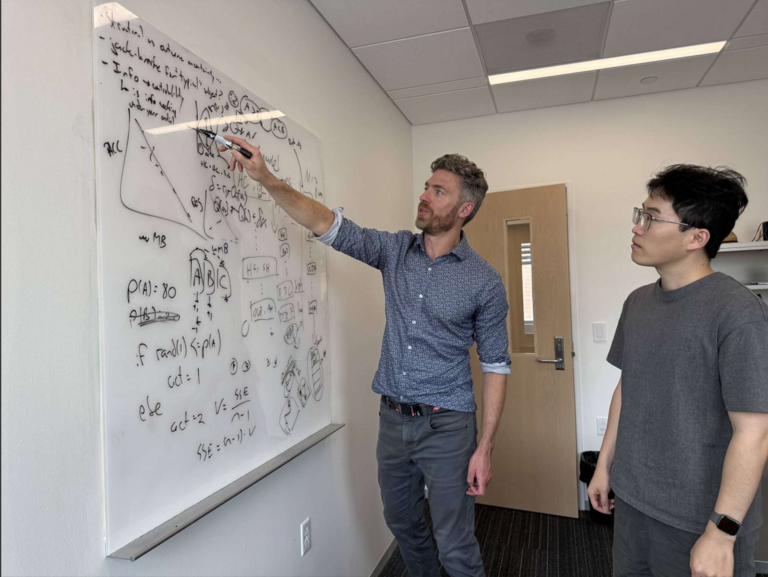
Starting off as an English and creative writing major, Cockburn hoped to one day attend the Iowa Writers’ Workshop. But, as he neared the end of his program, he developed an interest in computer science instead—and was surprised by how much he already knew.
"There are a lot of similarities between writing poetry and writing code," he said. "In both, you're trying to distill an idea down to its core and communicate that."
That newfound interest led him to pursue a joint master’s degree in computer science and psychology. There, he became interested in using neuroimaging, computational models, and mathematical models to study how the brain solves problems, with the goal of recreating similar processes in computers.
Following his master’s programs, he earned a PhD in computational cognitive neuroscience, further expanding his research at the intersection of psychology, neuroscience, and computation.
Predicting brain activity
Cockburn’s current research examines how the brain makes predictions and uses those predictions to guide decisions. He uses mathematical models to explore how things like fear, anxiety, or compulsions we don't quite understand influence these processes and, ultimately, the decisions people make.
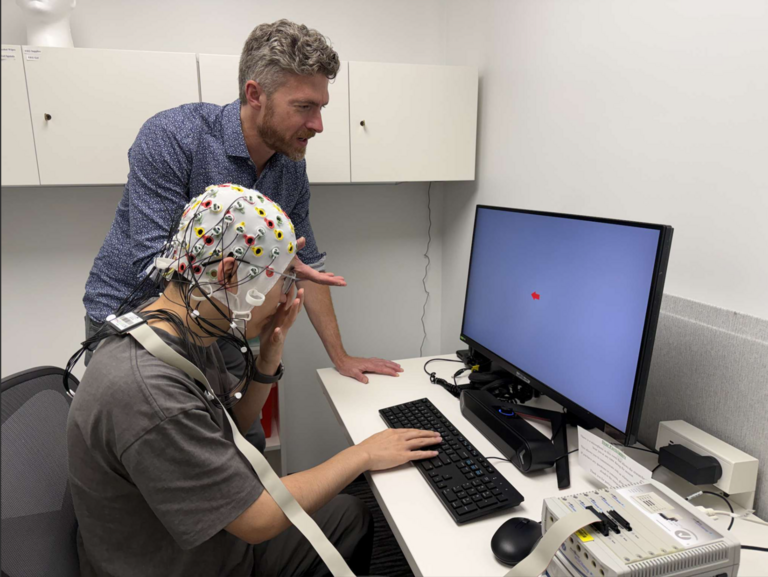
"My lab is looking at learning and decision-making, but from a mathematical foundation," Cockburn said. "The benefit of that is, if you have a mathematical formulation, you can make very strong predictions which we can go out and test. More often than not, we discover that we were wrong (or at least not exactly right)—but usually we can get a pretty good sense of where we went wrong, refine our models, and do a better job next time."
By providing insight into how the brain makes decisions, these predictions could help advance diagnostic tools and interventions in mental health care, an area that has long motivated Cockburn’s research.
One of Cockburn's current projects targets psychosis in schizophrenia patients. Though the project is still in the early stages, he believes it might be possible to one day predict the onset of psychosis a week before it sets in using simple at-home tests.
"Ideally, we could one day use what we learn from our understanding of the brain and how it functions with the body and our environment to able to reliably predict onsets or upcoming mental health events and intervene before they even happen," he said.
No straight path
Cockburn didn't end up at the University of Iowa for the reasons he thought he would as an undergraduate but is proud to be part of the Department of Psychological and Brain Sciences.
"There's a history here of amazingly significant work related to the brain and psychology in general, and resources most institutions would only dream of," he said.
Despite his journey being unconventional, Cockburn wants to remind young people that you might end up where you wanted to be anyway.
"There's no straight path to anything," he said. "You can start off in creative writing and end up doing computational neuroscience. It takes all types [of people] to help us understand what's going on in our brains."