
By Claire McGranahan
Associate Professor and DEO of the Department of Religious Studies, Paul Dilley, is a scholar of the ways humans connect and communicate across centuries.
His scholarly activity spans the globe and boasts multiple groundbreaking discoveries—and still, a researcher at heart and by practice, he remains curious about finding new ties between ancient texts and modern interpretive strategies, including digital humanities.
Dilley attended a math-and-science high school in New York City, but his curiosity about religion led him to study Gnostic texts, especially The Gospel of Thomas, a collection of sayings attributed to Christianity’s Jesus. This interest drew him into Greek, Latin, Syriac, and Coptic languages, and eventually to Berlin as a German Chancellor Fellow, where he explored Manichaean writings. Far from abandoning his analytical roots, Dilley’s affinity for structure and precision became the foundation for examining the abstract world of language through the intersecting lenses of ancient tradition and modern communication.
Dilley finds that religious and canonical writings are "very rich" in that they can be understood in many different ways. He draws a parallel between textual interpretation and data analysis, which challenges the common assumption that data is objective or factual.
“There are all kinds of ways in which any text or data set should be contextualized and understood, which doesn't take away from its utility,” Dilley said. “It just kind of helps complicate it and make it more interesting."
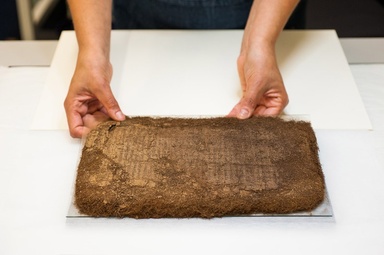
This reflects his broader educational philosophy about developing students' capacity for "generous understanding of the potential of human interpretation" across different types of materials, whether ancient religious texts or modern data sets. Before joining the University of Iowa faculty, Dilley was already recognized as an innovator. Among his many digital breakthroughs, one stands out: collaborative research funded by a National Endowment for the Humanities grant to develop ways to edit previously hidden texts that are made legible through advanced imaging, such as X-ray tomography and multi-spectral imaging (MSI).
“It’s unbelievably exciting, of course,” Dilley said of the experience. “It was because it was a completely unknown text, and I tried so hard to read it before, but now it was finally revealed with multi-spectral imaging.”
Since coming to Iowa, he has continued to push boundaries, elevating the university’s reputation through his pioneering work. Dilley's experience with machine learning is a driver in the future of his work with the next generation of students and the emergence of the latest disruptive technology, artificial intelligence (AI). In spring 2026, he will be offering a graduate-level seminar called Interrogating Artificial Intelligence: Exploring New Ancient Worlds, which will address ethical questions surrounding AI in regard to intellectual property and environmental sustainability, which students often raise.
“Ancient and medieval literature has always been at the forefront, in some ways, of digitization,” Dilley observes. “For example, the Perseus Digital Library was already in the early 1990s trying to come up with a corpus of electronic texts that students could interact with for free.”
While using collaborative, open-access tools has historically been a part of higher education, “it also means that it's not the sort of thing that a large language model (LLM) for example, is built to work on as a training set. The LLMs are for contemporary languages, and above all, for English. So it’s interesting thinking about how they work with a lower resourced language like Greek or Latin or Coptic, and really highlight what kind of insights they bring, but also what sort of holes or gaps there are in their output."
Dilley is one of the University of Iowa's inaugural Provost AI Fellows charged with innovating curriculum through the lens of AI and contributing foundational courses to the university’s new AI certificate, which debuts in fall 2026. Fellows will come together regularly to align on certificate goals and exchange ideas for strengthening AI education across campus.
For Dilley, the humanities are essential for interpreting AI outputs: “The question of how AI arrived at its answer and how it should be interpreted can’t really be asked without a humanist perspective.”
The 100th anniversary of Religious Studies at Iowa in fall 2026 will coincide with the planned merging of the departments of Classics and Religious Studies. As this reimagined department moves into its second century, Dilley is optimistic about the possibilities that are ahead for the new unit.
"I'm excited to see what kind of new courses will come out of the merger in the next several years," he says, envisioning a "big tent approach" that fosters productive discussion across disciplinary boundaries.