By Fatima Salinas
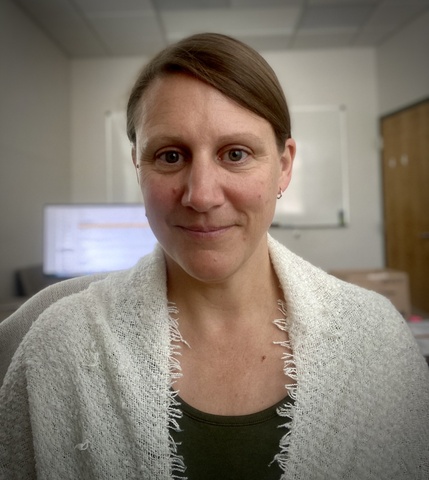
What started as a love for the outdoors has taken Emily Finzel from hiking trails to exploring the Earth and its resources, first as a geologist and now, in the classroom. Today, she serves as the Departmental Executive Officer of the School of Earth, Environment, and Sustainability (SEES) in the College of Liberal Arts and Sciences.
Finzel’s curiosity about how the Earth has been shaped now guides her leadership of the school. With its recent merger of several environmental programs, she envisions the school as a place where students can explore everything from fieldwork to policymaking, while gaining the skills and perspective needed to address today’s environmental challenges.
Read about Finzel’s vision for the School of Earth, Environment, and Sustainability:
Tell us a little bit about your background and role in the School of Earth, Environment and Sustainability.
My background is in geology. Before I came to the university, I worked for ExxonMobil for a few years as an exploration geologist where I located, mapped, and evaluated potential oil and gas resources.
I've been at Iowa since 2012 as an assistant professor. Since then, I have established my research group and broadened my teaching portfolio. Today I am a full professor and the DEO of the School of Earth, Environment and Sustainability.
What initially sparked your interest in earth and environmental sciences, and what areas do you focus on?
My interest was initially sparked by a love of the outdoors, trying to understand what I was looking at when I was out hiking around and enjoying nature—how it was formed, and what was the history there? A curiosity in general about the Earth. My specialization is looking at the history of the Earth's surface in terms of the movements of the continents, the building and erosion of mountain belts, the opening and closing of oceans. I look at the record that's created by those events in sedimentary rocks.
What was the vision behind combining programs to be under one school?
It's really following the modern trends of what society needs for people who study the Earth and the environment. We looked at what our students needed in terms of training to be competitive in the workforce, what our faculty were interested in researching, and where we could grow into new areas that had more connections with society.
Before the school was created, there were different pieces of environmental programs spread through different academic units, and what we really wanted was to have one place, one door, where students could come in who were interested in studying the environment and sustainability and related topics.
What are you excited about regarding growth in SEES in the upcoming years?
We have hired new faculty for fall 2025, and we have searches going on for faculty to start in fall 2026. We expect to see a lot of faculty growth, and I'm really excited about that for a couple of reasons: one, because it's going to change the type of research that's done in the school and really broaden it and give us more opportunities for collaboration. And the second piece is that we'll be able to grow our curriculum to meet the students' needs, so that they are ready to go out and get jobs when they finish with us.
What opportunities do you think this merger will create for current and future students?
For students, the big advantage is access to broader training and a wider range of faculty expertise. Many come in with an interest in the Earth, environment, or sustainability, but aren’t sure exactly which direction to take.
That’s why the curriculum is designed so all students—no matter their major—start with four core classes that introduce them to the different pathways within the school, all while counting toward their degree. It’s a bit like a “sorting hat” for Earth, environment, and sustainability, helping students find their path without losing time or money.
Many graduates go on to work in industry and consulting fields related to environmental issues, both in Iowa and beyond. As environmental challenges grow with our expanding footprint and population, this approach prepares the next generation of thinkers and problem-solvers who can help society coexist with the planet in a sustainable way.
Is there anything else you'd like students to know about SEES that we haven’t touched on?
One of the unique things about the school is that it combines the natural and social science aspects of Earth, environment, and sustainability. We have a very broad spectrum of majors available for students—whether you want to be out in the field collecting water samples or looking at soil samples, or you want to be in the Capitol making policy and decisions regarding laws and rules around the environment, you can come here. I think the main thing is that we have this very broad offering of majors for students, and that's pretty unique to any other universities comparable to Iowa.