
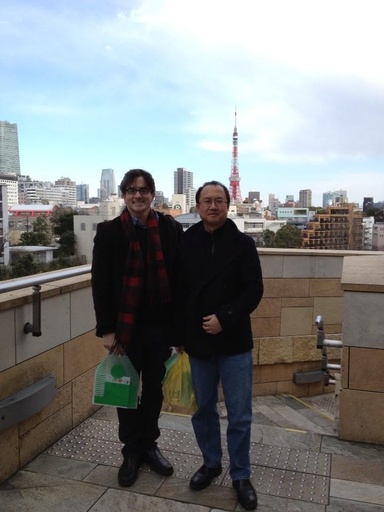
From Tokyo's sprawling cityscape to Kyoto's centuries-old temples, 20 University of Iowa students will find new inspiration for their fiction writing this winter.
The trip is the first run of the Japanese Writing Program, a new study abroad opportunity developed by University of Iowa’s International Programs and the Department of English in the College of Liberal Arts and Sciences. Students will spend about a week in each city, and they will write fiction the whole way through.
Past the usual destinations
The English department already sends writers abroad. A winter creative writing program in Greece, started by nonfiction professor John D’Agata, has been in place since before the pandemic. A summer program in Ireland runs each June and July. Stecopoulos wanted to add a destination outside Europe.
“One of our goals in the English department is to shape global citizens,” he said.
He also knows his students: “Gen Z loves Japan.,” Stecopoulos said. Many are interested in anime and manga, while creative writing majors often explore science fiction and fantasy, genres that overlap with Japanese popular culture.
Stecopoulos studies 20th-century American literature, and he has colleagues in Japan who study it, too. He spent a month there in summer 2025 giving lectures and meeting with them. During that visit, with promised financial support from International Programs, he explored whether a writing program to that destination could work.
A new muse
“Foreign cultures will serve as the new muse, if you will,” Stecopoulos said. “Students may write fiction in Japan “that they might not generate in Iowa City, Iowa, or even in the United States.”
Tokyo gives them scale.
“If you go there, it looks like one city after another receding into the distance,” he said. “I’m from New York originally, and New York seems small to me when I’m in Tokyo.”
On a high-speed bullet train, students can traverse the 177- mile distance between cities in just around two to three hours.
Kyoto is smaller, with temples and preserved medieval streets. Lanterns line the walks near the river at night. Even so, the city keeps one foot in the future. Its train station, Stecopoulos said, “looks like you’re in a science fiction movie.”
He expects that most of the group will be seeing Japan for the first time.
Writing on the road
Students will explore both cities with local guides. In Kyoto, stops include the International Manga Museum and the Philosopher’s Walk. In Tokyo, the group will visit a library devoted to Matsuo Bashō, the Japanese poet famous for his haiku.
Scheduled activities will generally wrap up by mid-afternoon, leaving students time to write first and explore on their own after.
Stecopoulos teaches a genre fiction course on the trip and will assign writing exercises throughout. Students will create short works across genres, from autofiction and science fiction to romance, along with a piece in a genre of their choosing.
Before leaving, students will also read Japanese literature in translation. Stecopoulos plans to assign Haruki Murakami’s Norwegian Wood, since the group will take a Murakami tour of Tokyo. Stories by Yukio Mishima are also likely, ahead of a visit to his library.
Iowa connections run through the trip, too. A guest speaker familiar with both U.S. and Japanese literature is planned for each city.
The Kyoto speaker has been a guest of the university’s International Writing Program and has visited Iowa City three times. In Tokyo, Stecopoulos hopes to host a colleague who has researched the IWP and visited Iowa several times.
Allison McClung, a second-year PhD student in English, will travel as the program assistant. She majored in Japanese studies and English at the University of Oklahoma, and is nearly fluent in Japanese.
“I like the idea that there are pre-existing Iowa connections embedded in this program,” Stecopoulos said.
Behind the scenes
As the English department’s partner on the program, International Programs has been involved from the start, from helping coordinate Stecopoulos’s first exploratory visit to handling contracts with the study abroad provider and travel paperwork.
Stecopoulos credits the office with supporting the English department’s broader study abroad efforts: “They’ve been wonderful.”
The English department hopes to make this trip to Japan a recurring winter opportunity, potentially alternating with its creative writing program in Greece.
Stecopoulos hopes students come home with a story worth keeping. “I hope they produce some fiction they like that they can develop later,” he said.
He also hopes the trip opens another door for participants. “I hope they want to go back to Japan or other places in East Asia,” he said, “and other places in the non-Western world.”