By Fatima Salinas
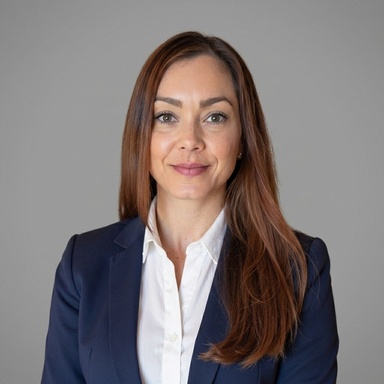
For Claudia Pozzobon Potratz, learning Spanish is about more than mastering grammar or vocabulary. It is about understanding how language shapes identity, family, culture, and belonging.
As an assistant professor of instruction in the Department of Spanish and Portuguese, Pozzobon Potratz brings those ideas into her teaching through SPAN:3092: Spanish in the Community, a course that connects students with Spanish-speaking communities and local organizations throughout the Iowa City area.
From language learner to educator and researcher
Pozzobon Potratz’s path to language education was not originally planned. Born and raised in Mérida, Venezuela, she initially intended to study journalism before circumstances led her to pursue a degree in modern foreign languages.
“Languages always came naturally to me, and I quickly discovered how much I enjoyed studying them,” she said.
After earning an undergraduate degree, she pursued a master’s degree in teaching and learning of foreign languages and taught English as a foreign language and Spanish as a second language in Venezuela. She later came to the University of Iowa to pursue a PhD in language, literacy, and culture.
During her doctoral studies, her interests grew to include bilingualism, multilingualism, and heritage language education. Her research continues to explore how multilingual people develop and maintain their languages and how language connects to identity and community.
“Language is never simply a tool for communication,” Pozzobon Potratz said. “Language is also connected to identity, family history, community, and belonging.”
Taking Spanish into the community
Those ideas are central to Spanish in the Community. Pozzobon Potratz began teaching the course in the fall semester of 2022 and has continued to develop and reshape it, making it her own while focusing on how the course can best support students. A central part of that work is giving students opportunities to use Spanish with real people in real situations.
Students can volunteer with organizations serving Spanish-speaking and immigrant communities, including free medical clinics, food pantries, churches, and English-language programs.
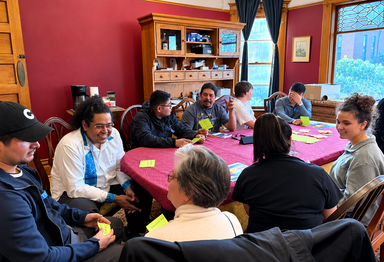
Pozzobon Potratz encourages students to approach their community partners as learners rather than as helpers.
Through these experiences, students encounter accents, vocabulary, and varieties of Spanish that may not appear in textbooks. They also begin to understand the diversity of Spanish-speaking communities in Iowa City and the different cultural, educational, and migration experiences within them.
“Language learning is fundamentally a social practice,” she said. “Language gains meaning when it is used to communicate with real people in real situations.”
For Pozzobon Potratz, that experience can also change how students see themselves as language users. Students who may hesitate to speak Spanish because they are afraid of making mistakes begin to recognize that communication does not require perfection. It requires listening, adapting, and building relationships.
For students interested in health care professions, those lessons can take on particular significance. Some volunteer at the Free Medical Clinic, mobile clinics, or University of Iowa Health Care, where they see how vulnerable people can be when they are sick, worried about a family member, or trying to navigate an unfamiliar health care system. In those moments, language becomes much more than vocabulary and grammar.
Students begin to recognize how empathy, listening, and intercultural communication help build trust. These experiences can help students see the people behind the services while helping them become more reflective, empathetic, and culturally responsive—not only as language users but also as learners, future professionals, and people.
Reflection is another important part of the course. After engaging with their community partners, students consider three questions: What surprised me? What intrigued me? What disturbed me?
The questions encourage students to examine their assumptions and think more deeply about language, culture, identity, privilege, and belonging.
Ultimately, Pozzobon Potratz hopes students leave the course understanding that Spanish is not simply a subject that exists within the classroom or somewhere abroad. It is already part of the linguistic landscape of Iowa.
“Spanish becomes more than an academic subject; it becomes a means of building relationships, strengthening communities, and connecting with people whose experiences may differ from their own,” she said.