By Bri Brands
Isaac Petersen, an associate professor in the Department of Psychological and Brain Sciences, started his career as a preschool teacher. There, he developed his current research interest in how children develop behavior problems.
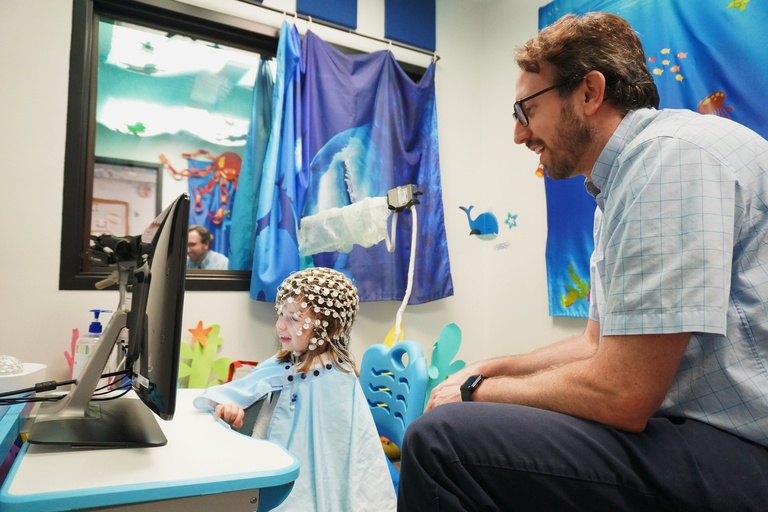
“I’m interested in how children develop the capacity to control their behavior, self-control or self-regulation, and how difficulties in that skill and process translate to dysregulated behavior,” Petersen said.
Petersen studies how childhood behavior develops. He looks at how brain functioning interacts with psychological factors like language ability and temperament, and with social factors like parenting and stress.
Understanding how behavioral problems develop
Petersen was initially interested in studying criminal behavior, but his work with children shifted his focus toward prevention. He realized that addressing behavioral problems at a young age could be more effective than treating them later in life.
“The reason I became a preschool teacher was to see the incredible power of early positive experiences for children,” he said. “I wanted to work to understand what the early mechanisms are in how behavior problems develop, so that we can intervene earlier and possibly prevent the development of later, more severe problems.”
After completing a PhD at Indiana University, Petersen accepted a faculty position at the University of Iowa, where he was drawn to the collaborative, supportive environment.
“I get to feel dumb every day and learn from others who are way smarter than me,” he said. “We’re constantly pushing the boundaries, testing new questions, and learning something new.”
Pushing boundaries and exploring new methods of study
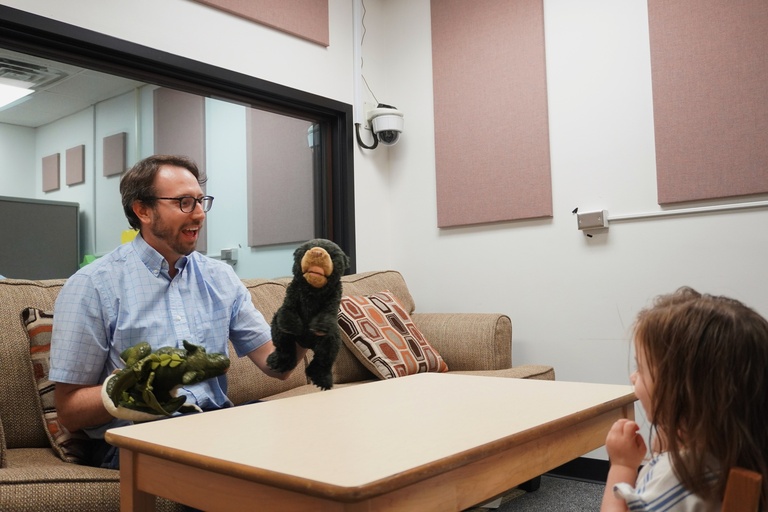
Part of pushing boundaries includes studying how behavioral and mental health problems develop over a lifetime.
Though it can be challenging to study the same group of people over an extended period, the greater challenge is understanding how behavioral difficulties appear differently at different stages of development.
“As [children] develop, their behavior problems tend to become more covert,” he said. “Instead of physical aggression, you’re going to be more likely to see indirect forms of aggression, relational aggression, substance use, and other things that are more covert misbehavior.”
Petersen and his colleagues are developing new assessments that will chart changes from infancy to adulthood.
Petersen’s research also informs his clinical work, where he oversees a group of graduate students. Alongside his students, he leads trainings that help parents better understand and respond to difficult behavior in children. His work with families provides real-world insights that he can bring back to his research.
“What we learn in the clinical context can inform the research questions and hypotheses that we pursue, and the research informs the clinical work,” he said.
For Petersen, understanding how children’s behavior develops is ultimately about finding better ways to support them early in life.
“[My] goal is to understand what factors influence children’s behavior development, so that we as a society can develop more effective prevention programs, identify people at risk, and provide them better supports earlier on, so that all children are better positioned to thrive,” he said.