By Jessica Lien
University of Iowa English PhD candidate Jennie Sekanics has received a 2026–27 American Association of University Women (AAUW) American Fellowship, a highly competitive national award supporting outstanding graduate scholars.
According to AAUW, approximately 60 fellows were selected from more than 600 applicants nationwide for the 2026–27 award year. The fellowship includes a $25,000 award and recognizes scholars whose work demonstrates exceptional promise and impact.
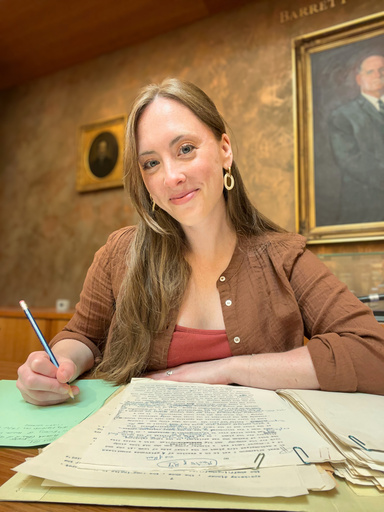
Sekanics, a literature and culture scholar specializing in the energy humanities, studies how different forms of fire shape American identity and ideas about modern life. Her dissertation, "Pyromodernity: Media and Modernisms of Fire," examines how fire appears across American literature, media, and culture, and what those representations reveal about the American experience.
“Fire is often sidelined in conversations in the energy humanities. It's positioned as a terrible consequence of climate change, which it is, but our relationship with fire is also incredibly intimate and varied. It's something we depend upon for almost all our experiences," Sekanics said.
Her research explores everything from urban fires and dynamite explosions to oil fires and wildfires, tracing how Americans have used, depended on, feared, and imagined fire over more than a century. By studying those relationships, Sekanics seeks to better understand how fire has influenced American culture, identity, and ideas of progress and energy.
Yet, for Sekanics, fire is not only a significant theme in the American cultural imagination. Fire’s ability to create and destruct also shapes artistic techniques. Her scholarship reveals how fire might have inspired the fragmented form of American fiction and the nonlinear style of American film across the 20th century.
The fellowship will provide dedicated time for research, writing, and archival work. Over the next year, Sekanics plans to continue examining historical newspapers, advertisements, and literary and visual texts, while also conducting archival research connected to writers whose work plays a significant role in her dissertation.
"To be able to have full dedicated time to focus on my research is huge," she said. "I'm excited to have the time to give these subjects the attention they deserve."
Sekanics credits support she has received from the Department of English, particularly from faculty mentor Harry Stecopoulos, for emboldening her to pursue opportunities to show her work and build connections with scholars in her field. She’s also grateful to Professor Claire Fox, who helped shape her project narratives for her application.
For Sekanics, the fellowship is both recognition of work already completed and an opportunity to continue pursuing a project that connects environmental questions, literary studies, and American culture through fire—one of humanity's oldest and most consequential forces.