Two College of Liberal Arts and Sciences faculty members have been selected for the 2026 Scholarly Teaching Program, a learning community designed to develop participants’ teaching practice within and beyond their disciplines.
As a part of the program, Elizabeth Crawford, visiting assistant professor in the Department of Rhetoric, and Spencer Jones, a visiting assistant professor in the Department of Rhetoric and the Department of English, are members of a cohort that engages in peer discussion and explores evidence-based literature to help enhance teaching methods.
“The Scholarly Teaching Program offers teaching-focused faculty the opportunity to join a cross-disciplinary community, and to learn from each other as they explore evidence-based teaching practices,” said Eva Latterner, associate director of the Center for Teaching. “As part of the program, participants attend a national teaching and learning conference, and report returning with increased confidence in their teaching and valuable connections with other faculty on campus.”
Crawford and Jones will attend the American Educational Research Association annual meeting in Los Angeles in April.
Learn more about each CLAS participant and their teaching philosophies:
Elizabeth Crawford
Crawford, in her second year of a three-year teaching appointment, instructs three rhetoric courses per semester, focusing her teaching efforts on creating a tight-knit community of critical thinkers.
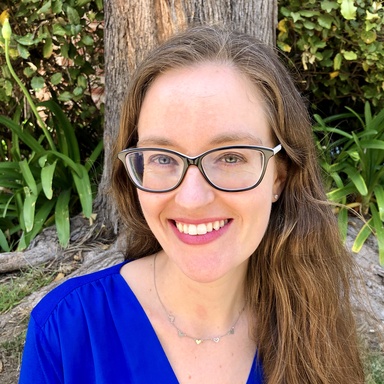
“A key tenet of my teaching philosophy is to have students consider alternative points of view—that's what college is for. So, you come in with your opinions, and we respect your experience,” she said. “But also, the point of college is to be exposed to what other people think and other perspectives. I don't tell students what to think, but I want to give them a lot of different ideas to weigh and compare with their experience.”
Working with students is the best part of Crawford’s day, she said. No matter the mood she starts the day in, she knows she will leave the classroom smiling.
“It’s always a one-of-a-kind experience to teach a group of students, and Iowa students are awesome,” she said. “They come from a really diverse set of backgrounds, and they have a lot of big ideas and opinions about things, so getting to know them and hear their opinions is a big honor.”
As Crawford meets with her cohort monthly, she continues to be excited about the ways it supports teachers, brings them together in conversation, and enhances professional development. She has already learned several new pedagogical strategies that have helped strengthen different aspects of her teaching.
At the conference, she looks forward to hearing peers share their research on best teaching practices and explain how expert teachers study new classroom techniques, especially involving artificial intelligence.
“The exciting thing [about AI] is the way that my colleagues and I are responding to this moment,” she said. “I see my colleagues getting together and having conversations about how they really care about student learning. They want students to build their brains and become good writers. We think it's more important than ever to be a good writer in the age of AI.”
Crawford joined the department’s Artificial Intelligence Committee in the spring of 2025, helping to institute a new learning objective around information literacy and how to use AI critically and responsibly. Since then, she has received feedback from her students about their desire to keep learning the critical skills that Rhetoric teaches.
“What I’m hearing from my students is that they want to come to college to learn,” she said. “They don’t want to come to college to use AI and sail through. They’re going to be really essential partners with their teachers in helping us figure out what we are going to do to keep building these skills.”
Spencer Jones
Though Jones is a first-year visiting assistant professor, she was a teaching assistant for the Department of Rhetoric from 2022 to 2025 while she was a graduate student in the Nonfiction Writing Program. She now teaches two sections of Rhetoric and one section of Advanced Creative Nonfiction.
Through it all, she has seen students of a wide variety of majors develop an interest in rhetoric and learn to recognize its importance in their education.

“Rhetoric used to be this art form that was practiced by a small elite group of men in the ancient world, and now we live in a society where anybody can make an argument on their phone literally at any moment, and it can go viral at any moment,” she said. “There's been this huge democratization of rhetoric phenomenon in recent history, and we talk about that phenomenon and how that fundamentally reshapes everything that we experience in society.”
Jones is particularly interested in speaking with her colleagues and her cohort about what good reading instruction looks like in the classroom.
“There is this unstated assumption in college classrooms that, in high school, you learn how to read and then in college we teach you how to write better,” she said. “But the truth is that we are all always learning how to read and write better, but there's not a whole lot of explicit reading instruction that goes on in the college classroom.”
In the classroom, Jones tries to target her instruction just ahead of where students are as readers and writers, continuously pushing them towards the higher capacity needed for other college courses. In order to do this, she heavily encourages engaged participation for all of her students.
“There’s not going to be a huge amount of learning if students are not talking to each other in substantive ways,” she said. “The most successful students are the ones who are engaged in talking to each other.”
Looking forward to her future as a Rhetoric professor, Jones is excited by what the Scholarly Teaching Program will do for her.
“As a country, it feels like we are on the precipice of a big historical shift, a big cultural shift, a big political shift,” she said. “That's always, in some ways, the most stressful time to be studying Rhetoric, but it's also the most exciting and engaging.”