By Jessica Lien
Dylan Johnson is a doctoral candidate in the Department of Mathematics within the College of Liberal Arts and Sciences. He studies shadows.
Well, not exactly.
"I work in operator theory. I measure how things are twisted around. It turns out, and someone figured this out about a decade ago, these numerical ranges are the shadows of quantum states."
The shadow metaphor captures it well. If you take a three-dimensional shape and shine a light on it, you can learn a lot just by studying what falls on the ground. Move around it, look from different angles, and those two-dimensional shadows start to tell you what the full shape looks like. In operator theory, the numerical range works the same way—a 2D view into a much higher-dimensional object. In low dimensions, the shapes are tidy: circles, ellipses. As the dimensions climb, they get sharp edges and strange geometries.
“There's no picture for it,” Johnson said. “But there's a way to describe it, and that turns out to be enough.”
If it sounds mind-bending, that's because it is. It's rigorous, theoretical mathematics.
That's why Johnson is already deep in equations by 6:30 a.m., making the most of the morning before his three young children wake and the day becomes a little more chaotic.
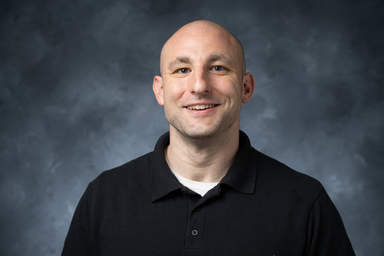
"I try to do creative things where I'm working on the problem, and then I'll do lunch and go help my wife with the kids. When I come back in the afternoon, that's when I do things like reading, studying, teaching."
As a PhD fellow and as a father, time is a key constraint. "My schedule, including teaching duties, can make it so I have less control over when I can do things. By five o'clock, my wife has been chasing the kids around all day and it's my turn."
But being a dad, Johnson said, has made him sharper as an instructor and more attuned in the classroom. "The same patience required to teach a child to read transfers directly to a student meeting calculus for the first time," he said. "Easing that anxiety is key—it's okay to be wrong; I'm wrong all the time. I really want to pump up the wins and help so they want to overcome that hurdle."
Creating structure from chaos
When asked how he spends his time, Johnson describes it in mathematical terms: "I feel like my life is kind of split into thirds: time for math, time for teaching and everything else in the program, and time with my family."
The structure of a math PhD shifts considerably from year to year. "When I started out, I was taking three or four classes at a time,” Johnson said. “When I started, I also had qualifying exams. They're tough, and those were really my focus that first year."
“As you move through the program, that shifts,” said Johnson. “By your third year, you're down to one or two classes a semester. In your fourth and fifth years, you're not taking classes at all—you're doing research.”
Johnson's home department has worked deliberately to make that progression navigable for graduate students who arrive with busy lives. "The Department of Mathematics has a proud tradition going back at least 30 years of making its doctoral program accessible to students from a wide variety of backgrounds and current circumstances," said Ryan Kinser, department executive officer. "We do this by striving to help every student establish a one-on-one mentoring relationship with a faculty member in addition to their research supervisor.”
Johnson’s path to a PhD was made possible in part by a Graduate Assistance in Areas of National Need (GAANN) fellowship, through a Department of Education grant awarded to the Department of Mathematics. This fellowship supports graduate students with strong academic records and financial need who are pursuing the highest degree in their field.
The path to PhD and the career beyond
While it’s theoretical mathematics, Johnson’s area of study has implications that reach into developing fields: "The U.S. has a clear need for a steady stream of talented individuals from all backgrounds to enter graduate programs that offer high-quality training in mathematics research and teaching," Kinser said. "Our nation's research enterprise is a key component of the engine that drives economic strength in the global marketplace."
After completing his degree, Johnson is considering teaching, industry positions, and an officer role in the Navy. Mathematicians working in numerical range are now being recruited by quantum computing companies, an opportunity that barely existed a decade ago. "If you've shown you can do math research," Johnson said, "they trust you know how to teach yourself.”
Grounded in the things that matter
While there are applications for his research, Johnson is highly motivated by the intrinsic value of the work.
"I find linear operators interesting in their own right," Johnson said. "There are people who make beautiful music without some ulterior motivation, and there's the same feeling with math. You study it because it gives you something. There’s discovery. It gives you all this surprise." He paused. "It also happens to be a really good tool for figuring things out."
Johnson still makes room for the things that keep him grounded. "I love my weekends with my kids. We usually go to a riverfront park in town, and there's always something interesting for them. It gets me moving around and playing with them—a little bit of nature right in the middle of the city. They're always fascinated. There's always something growing or scuttling around that they want to check out."
It's the same instinct that brought him to operator theory in the first place: the pull of attention and curiosity to things one might not yet fully understand.
While it can be challenging at times, Johnson considers this time in his life a privilege and feels a deep sense of responsibility. "I really do feel an obligation to the people who invested in me,” said Johnson. “This fellowship was an important reason why I’m able to do what I do, and I feel I have a duty to get things done.”
But like raising children, research is about deferred gratification: “Sometimes with math it takes a generation before you get to see the results in full,” Johnson said. “I’m grateful for this award, and it’s my aspiration that we’re all going to benefit.”
To learn more about funding an advanced degree in mathematics at University of Iowa, visit the Graduate Funding page on the department's website.