By Bri Brands
While attending a seminar as a master's student, School of Earth, Environment, and Sustainability Assistant Professor Valerie Payré encountered an idea that would define her career: research done to explore Earth could just as well be done to explore Mars.
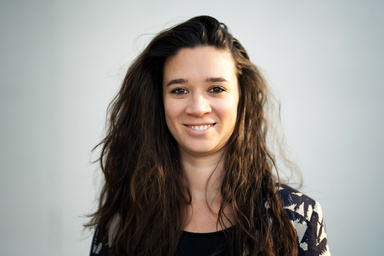
Now, Payré’s research focuses specifically on volcanoes on Mars; how they formed and how they have evolved over time.
Until about 10 years ago, scientists believed volcanoes on Mars were made of the same material as the volcanoes in Hawaii. They now understand there is a different chemistry in the lava flows and magmatic terrains, including granitic rocks.
“Silica-rich rocks like granites on Earth usually form on continents, but on Mars there are no continents,” Payré said. “The goal is to try to understand how they form.”
To conduct her research, Payré is on the Mars 2020: Perseverance Rover team, a project sponsored by NASA that is collecting core samples of Martian rock.
Long before working with NASA, Payré was already conducting out-of-this-world research. While she was a PhD student at Université de Lorraine in France, Payré worked with instruments on board the Curiosity rover, the largest rover sent to Mars at the time of its 2011 launch.
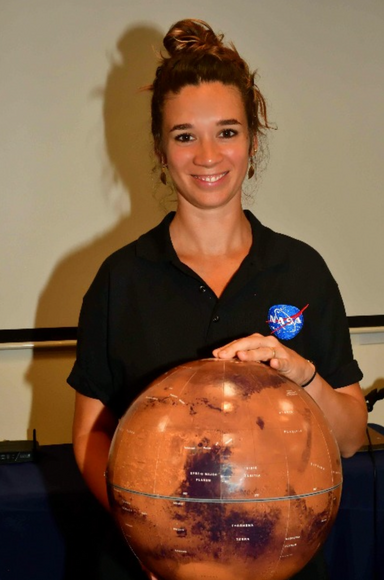
At the University of Iowa, Payré is able to expand her research by working closely with other departments in the College of Liberal Arts and Sciences that have staff and faculty dedicated to planetary missions.
“I collaborate with the Physics and Astronomy Department and Protostudios on some research projects. For example, they are helping with designing and making instrumentation. It's not everywhere that you have two departments that can collaborate like that,” she said. “It’s great to work with people within the department, but if you can work outside, that’s even better.”
Payré is currently working on a mission to build a helicopter to fly into a canyon on Mars and record information about the depth profile of Mars’ crust, from formation to present day. Looking forward, she also hopes to expand her research to Venus.
“We don’t know anything about Venus. We have almost no knowledge about it,” she said. “We don’t even understand the surface, so it’s really cool to better explore Venus.”
When she’s not doing research, Payré can often be found doing outreach and presentations to Iowa City and surrounding areas in which she shares her findings and gets people excited about a topic they rarely get to hear about.
She also focuses on sharing her work with young women in the community and inspiring them to pursue a STEM career.
“As a woman in STEM, but also in planetary missions, I feel like it’s important to show the young girls that you can do this work,” she said. “It’s accessible, and you can do it. You can make it work.”