By Bri Brands
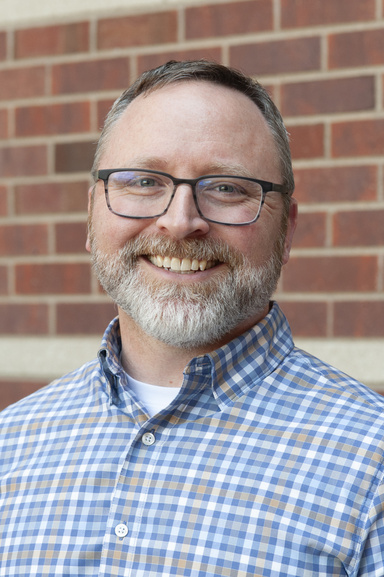
For years, Scott Daly, associate professor in the Department of Chemistry, has been working with his student research team to understand an area of chemistry so few chemists have dared to touch. Now, Daly and his group have received prestigious recognition for that work.
On Oct. 30, the article “Direct Measurement of Covalent Three-Center, Two-Electron M-H-B Bonding in Zr and Hf Borohydrides using B K-edge XAS” was selected as a “ChemSci Pick of the Week” article.
Chemical Science is the flagship publication of the Royal Society of Chemistry and features “findings of exceptional significance from across the chemical sciences.”
Each week, the Royal Society highlights a “ChemSci Pick of the Week,” releasing an embargoed article from the journal in order to highlight cutting-edge science.
Daly’s research group, made up of postdoctoral scholars as well as graduate and undergraduate students, uses X-ray methods to examine chemical bonding in metal-containing compounds and determine how it affects their reactivity and properties.
The research, Daly said, matters for everything from catalytic processes that turn basic chemicals into everyday products to answering fundamental questions about the elements at the bottom of the periodic table.
In latter work funded by the National Nuclear Security Administration, the Daly group is working to investigate how hydrogen interacts and bonds with nuclear elements such as plutonium.
When plutonium is exposed to hydrogen, it undergoes corrosion reactions—similar to how iron rusts when it is exposed to oxygen, Daly explained.
“When it’s exposed to hydrogen gas, the metal basically degrades by forming metal-hydrogen bonds. It starts to flake off and disperse,” he said. “We’re very interested in understanding the nature of the hydrogen bonds that form with the metal.”
Because of radio-toxicity concerns with plutonium, the researchers must incorporate model complexes so they can isolate and study the metal-hydrogen interactions in a controlled environment.
The Chemical Science article takes a step back from plutonium and explores non-radioactive metals, using X-ray tools that they hope will eventually be applied to plutonium. They also use boron in these model compounds to configure the hydrogens in specific ways at the metal, and the boron further serves a spectroscopic handle to report on how hydrogen bonds.
The team prepared these model complexes and brought them to the Canadian Light Source at the University of Saskatchewan, where they were able to use their X-ray facilities to study metal-hydrogen bond characteristics at the atomic scale.
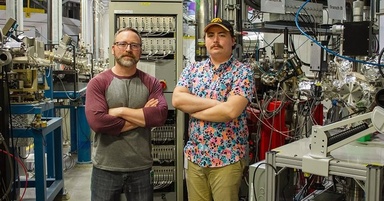
“We’re mainly interested in understanding, as we prepare a series of compounds, how does the bonding between metal and hydrogen change?” Daly said. “If we can understand how it is changing, we can perhaps correlate it back to chemical properties and reactivity.”
Daly’s interest in studying chemical bonds originates from the initial spark that got him into chemistry. Intrigued by the dawn of the nuclear age and the Manhattan Project, he wanted to be part of a larger solution.
“I was just fascinated by how scientists could come together in such a big way to address important problems or an important need at the time,” he said.
Now, he is grateful that his program has gained recognition, and the hard work of the students on his team is being shared with a larger chemistry community.
“The experiments that we described in this article were incredibly challenging, and it took years to do the measurements reliably,” he said. “There were a lot of late nights with me and graduate students working around the clock, troubleshooting and trying to identify spectroscopic features associated with the compounds.”
The compounds Daly and his team work with are extremely sensitive, decomposing as soon as they are exposed to air or X-rays.
These challenges, along with being unsure of what to look for, are likely why this capability has not previously been explored in depth, Daly said.
“I think that’s the thing I’m most proud of sharing,” he said. “We were actually able to overcome those technical challenges and make the measurements.”
Since the article’s publication, Daly has received a lot of positive feedback. Many researchers affirmed his findings, noting the difficulty of getting reliable, trustworthy data from these experiments.
Daly credits his group’s persistence as a key reason for overcoming the technical challenges that have held so many others back.
“This is not just recognition for me—it’s recognition for my students,” he said. “It’s their dedication that ultimately drove this project to this point. It takes a lot of hands.”