By Fatima Salinas
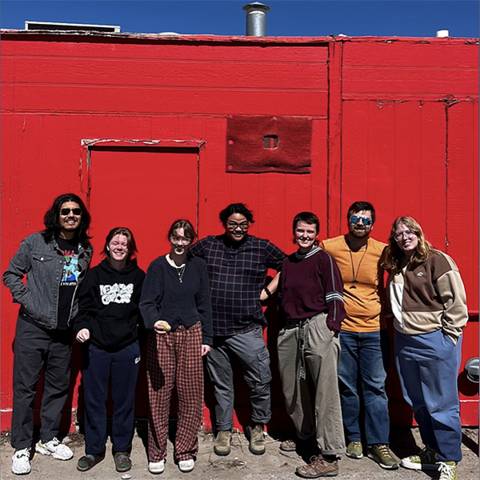
Professor and department executive officer Andrew Casto and 14 undergraduate and graduate students in the School of Art, Art History, and Design, which is housed in the College of Liberal Arts and Sciences, participated in the National Council on Education for the Ceramic Arts (NCECA) conference, held in Salt Lake City earlier this year.
Casto believes attending NCECA has a lasting impact on students. Each year, he brings a group of around 20, and he consistently sees noticeable growth in their studio work afterward. This year, students presented their work, and Casto was part of a panel discussion.

“There’s no other event that helps students see the larger ceramics world quite like this,” Casto said. “When they take part in presentations, discussions, or exhibitions, it raises the visibility of their work and shows the strength of what we’re doing at Iowa.”
Graduate student Javier Espinosa Momox, presented his work titled “Herencia Means Heritage,” which shared his collaborative work with ceramic artisans in Puebla, Mexico.
Supported by the UI Stanley Foundation, Espinosa Momox’s project allows factory-employed artisans time and space to create their own pieces outside of commercial production. His presentation highlighted both cultural heritage and the power of creative exchange.
Graduate student Shaun Mallonga’s work was selected for an international exhibition curated by Canadian ceramicist Martina Lantin. Hosted at the Leonardo Museum in Salt Lake City, the show featured nine artists from around the world.
Mallonga’s piece showcased the creative experimentation and technical range supported by the ceramics area of the school of arts, and art history.
Casto, who has attended NCECA for over 20 years, joined the group to help students navigate the exhibitions, presentations, and events. He also participated in a faculty panel to introduce CIRCA, the Consortium for Intercollegiate Research in the Ceramic Arts, a network he helped launch with colleagues from six universities to connect graduate ceramics programs and build academic communities.
He added that the opportunity to attend NCECA benefits not just the students but also the School of Art, Art History, and Design, as well as the college.
“Attending NCECA is tremendously valuable for our students and for the school’s reputation in the field of the ceramic arts,” Casto said. “We’re very thankful the school continues to support this opportunity each year.”